The choice between integrating existing systems and building or maintaining separate solutions is fundamental to business success. As a software development company, understanding and communicating the true costs behind these approaches is strategic and essential for clients seeking sustainable digital transformation. Let’s zoom in on retail and e-commerce environment. It is a great example.
The Costs of Fragmentation: Why Separate Systems Drain Resources
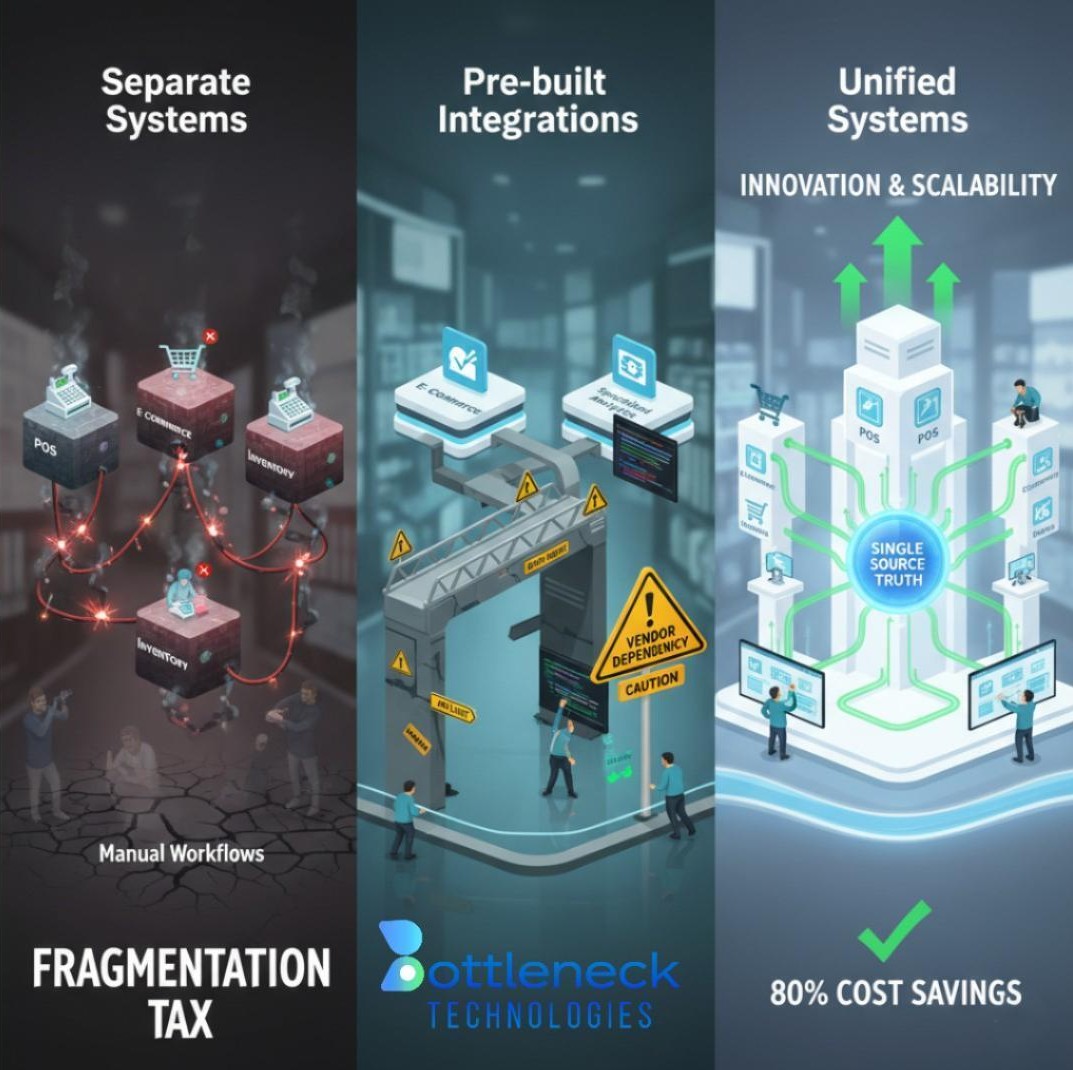
Maintaining several distinct systems for point-of-sale (POS), e-commerce, inventory, and customer management may seem flexible. Yet, these separate solutions come with what the industry calls a “fragmentation tax.” This tax manifests in:
-
Cumbersome integrations: Each new connection between systems requires development work, constant monitoring, and updates when APIs change. This takes developer time away from innovation and toward keeping the lights on.
-
Manual workflows: Staff often resort to error-prone, manual reconciliation across platforms, burning hours each week and creating duplicate data entries.
-
Higher risk and lower security: Multiple disconnected systems increase the surface area for vulnerabilities. Each integration point can become a failure point.
-
Operational inefficiency: Training staff to use multiple interfaces, juggling vendors, and reconciling data creates friction day-to-day.
The cost? Delayed time to market, inconsistent customer experiences, and higher ongoing expenses in security, maintenance, and support. Retailers interviewed in industry surveys summarize it: “We are in the business of selling, not building custom tech or spending days troubleshooting.” The opportunity cost is steep: more time maintaining than innovating, less capacity to grow or pivot as needed.
Pre-built Integrations: Sometimes a Necessary Middle Ground, But Not a Cure-All
While integrating best of breed solutions offers benefits and allows access to specialized capabilities, the pre-built integrations still demand significant resources:
-
Limits on flexibility: One-size-fits-all integrations rarely fit unique workflows without custom development.
-
Vendor dependency: Changes or upgrades on either side of the integration can break connections, requiring urgent patches and updates.
-
Maintenance burden: Pre-built integrations bring technical debt, each bridge requiring monitoring and expert intervention as your business scales.
For high volume brands, technical limitations—API rate limits, latency, and complex error handling can negatively affect both performance and cost. The survey data is clear: businesses relying predominantly on pre-built integrations often spend more, struggle with data synchronization, and invest heavily in IT talent just to maintain baseline functionality.
Unified Systems: The Case for Deep Integration and a Single Source of Truth
From a software development standpoint, the enormous value lies in platforms built from the ground up for unified commerce:
-
Unified data model: Order, product, and customer data flow in real-time across channels with no need for constant API bridging.
-
Lower maintenance cost: Fewer integration points mean less troubleshooting and a reduced risk of system failure.
-
Operational consistency: Staff work within a single interface; changes propagate instantly, and customer experience remains consistent.
-
Scalability: When the business grows, adding new channels or features happens quickly and reliably—without architectural sprawl.
Real-world evidence supports this. Retailers who unify POS and e-commerce systems save up to 80% on total technology ownership costs, decrease support and maintenance expenses, and dramatically speed up time-to-market for new features.
Industry Best Practice: Transitioning from Integration to Unification
The retail and e-commerce software landscape increasingly favors unified commerce platforms, which are favored by leaders who shape consumer expectations and outperform their more fragmented competition. From software developers, the message is clear:
-
Focus on extensibility in a unified system, not on perpetual integrations.
-
Guide clients away from incremental “patchwork” solutions and toward holistic digital transformation.
-
Invest in scalable, future-ready architecture that supports business agility, innovation, and security.
Pre- built Integrations Have Their Place, But True Value Lies with Unified Systems
From the perspective of a software development company, integrations are vital for connecting specialized tools, however relying on them to bridge core business systems brings real, ongoing costs and complexity. The future is unified: systems built to operate seamlessly together, reducing technical debt and empowering both the business and its development partners to focus on growth, innovation, and true digital transformation.
Integrations are better than siloed, separated systems—as a transition. The real gains come with a unified architecture that streamlines operations and delivers a single source of truth across all channels and functions, saving costs, reducing risk, and enabling rapid innovation. Smart development teams and industry leaders already know unification is not just a technological trend, but necessity for future sustained commercial success.
At Bottleneck Technologies, we help clients identify which integrations deliver the most value for their business—and we build complete systems from the ground up when needed. Our team believes in informed decisions and provides clear, upfront discussions about costs, tradeoffs, and future implications.
The best solution is one that fits your resources and ambitions, growing seamlessly as your business evolves.
What challenges are you facing?
Contact us today for a free consultation or a comprehensive system assessment. Let’s move your business forward together.
contact@bottlenecktechnologies.com