Which Automation Technology Does Your Business Actually Need?
April 28, 2026
RPA, System Integration, and AI Agents
Automation is no longer a luxury reserved for Fortune 500 companies. Whether you run a mid-sized manufacturing operation or a growing small business, the question is no longer whether you should automate, it is which technology is right for your specific situation.
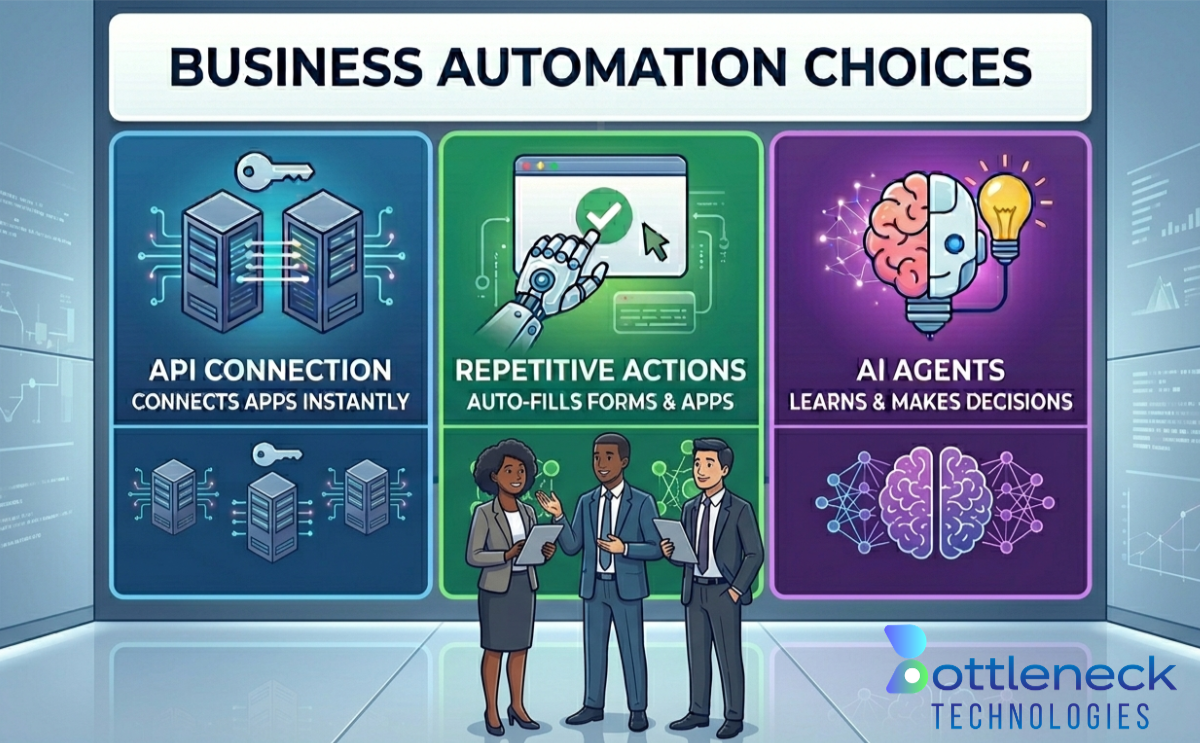
Three approaches dominate the conversation today: Robotic Process Automation (RPA), System Integration (APIs), and AI Agents. Each solves a different problem, fits a different budget, and suits a different type of organization. Picking the wrong one wastes time and money. Picking the right one — or the right combination — can transform how your business operates.
What Are We Actually Talking About?
Before diving into comparisons, it helps to understand what each technology fundamentally does.
System Integration (APIs) creates a direct, invisible pipeline between two software systems. When you submit an order on a website and it automatically appears in a warehouse management system, that’s an API at work. It is fast, reliable, and requires no human interaction, but it only works when both systems support it.
RPAÂ deploys software “bots” that mimic a human sitting at a computer , clicking buttons, copying data, filling in forms, and navigating between applications. The key advantage: bots don’t need an API. They work with whatever is on the screen, making them uniquely capable of automating legacy systems that were never designed to talk to modern software.
AI Agents go a step further. Rather than following a fixed script, an AI agent is given a goal and figures out the steps to achieve it. It can read unstructured data like emails and PDFs, make judgment calls, handle unexpected situations, and even orchestrate other tools (including RPA bots and APIs) to complete complex, multi-step workflows.
The Full Comparison:
Dimension | System Integration (API) | RPA | AI Agent |
How it works | Backend-to-backend data exchange | Mimics human UI actions via scripts | Reasons, plans, and executes toward a goal |
Decision-making | None; passes data as instructed | Fixed rules only, no decisions | Autonomous, context-aware decisions |
Data types handled | Structured only | Structured; partial unstructured | Structured and unstructured |
Handles exceptions | Fails; needs a developer fix | Requires manual escalation | Largely self-resolving |
Setup effort | High upfront development work | Low; fast to deploy | Medium–high |
Maintenance | Low; stable as long as APIs hold | High, breaks when UIs change | Low; self-adapts over time |
Speed | Fastest; real-time | Slower due to screen interaction | Fast for complex tasks; compute-intensive |
Scalability | Very high | Limited; more bots needed to scale | High |
Legacy system support | Only if APIs exist | Yes — UI access is enough | Partial; often relies on RPA for legacy |
ROI timeline | Months; longer to build but stable long-term | Weeks; fast wins are common | Variable; best ROI on high-value, complex workflows |
Best for (role) | IT teams, developers, technical architects | Operations managers, finance/admin, citizen developers | Innovation leaders, CXOs, complex workflow owners |
Best for (company size) | Mid to large enterprises with modern tech stacks | Any size; especially SMBs with legacy systems | Mid to large enterprises with high-complexity processes |
Top industries | Fintech, SaaS, e-commerce, modern healthcare | Manufacturing, banking, insurance, healthcare, HR, supply chain, retail | Finance, supply chain, IT support, legal, customer service |
High value use case | Real-time CRM ↔ ERP data sync | Invoice processing, KYC, payroll, data migration | Dynamic pricing, exception handling, multi-step approvals |
Key risk | Vendor API changes can break integrations | UI changes break bots; high maintenance | Cost overruns; unclear ROI; hallucination risk |

 Where Does Your Industry Fit?
Here is how a few key sectors stack up:
- Small and Medium Businesses (SMBs):
SMBs have historically been the natural home of RPA because of its low barrier to entry , but the landscape has shifted dramatically. Modern no-code/low-code integration platforms now give SMBs API-style automation at very small monthly cost, with no developer required. For any SMB running a modern SaaS stack (CRM, accounting software, e-commerce platform), these tools are the fastest and most affordable starting point.
AI agents are increasingly SMB-accessible too. Platforms now offer no-code agent builders that function like a virtual assistant , automating customer replies, scheduling, follow-ups, and lead nurturing without IT involvement. The biggest advantage for SMBs: AI agents scale without hiring, directly addressing the most common SMB constraint of limited staff and tight budgets.
Recommended path for SMBs:
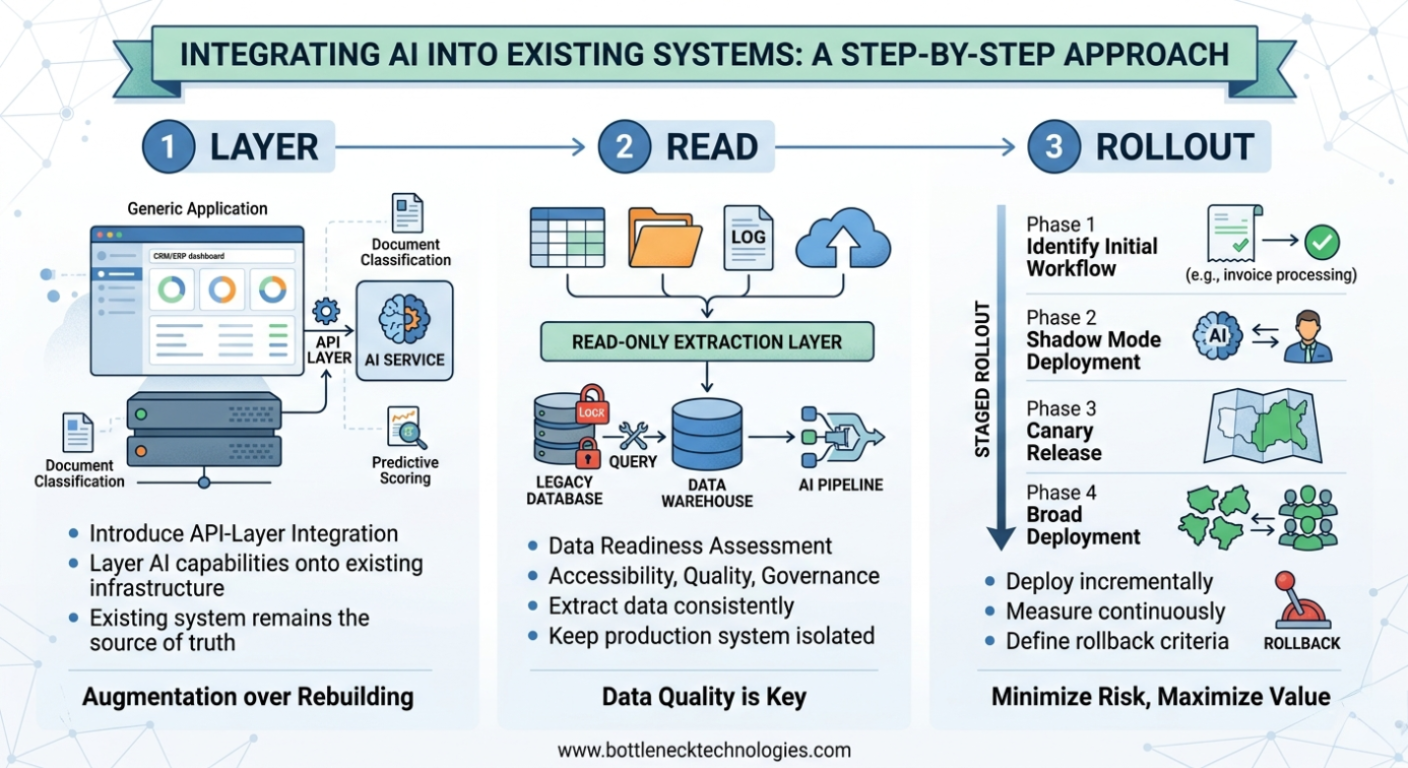
Start with no code platforms to connect your existing tools. Add an AI agent for your highest-volume customer-facing workflow. Only consider RPA if you have a legacy system with no API and a specific manual process bottleneck to solve.
Manufacturing:
Manufacturing is one of the strongest fits for RPA. The industry is built on legacy ERP, MES, and SCADA systems that were never designed with open APIs in mind. RPA bots handle purchase order generation, inventory monitoring, production schedule updates, and quality control reporting , all without touching the underlying systems.
APIs then extend the stack to connect modern cloud tools: supplier portals, logistics platforms, and procurement systems where modern integrations are available. AI agents are beginning to enter the picture for supply chain exception handling, dynamic demand forecasting, and interpreting unstructured supplier communications like emails and delivery notices.
Recommended path for manufacturers:
Start with one RPA bot on your highest-volume repetitive process (e.g., PO generation or inventory reconciliation), add API connections to your modern cloud tools, and layer in AI agents for cognitive workflows as your automation maturity grows.
They Work Best Together:
The most important thing to understand is that these three technologies are not competitors, they are layers of the same automation stack.
APIs form the reliable backbone for modern system connections
RPAÂ fills the gaps where APIs do not exist, particularly in legacy environments
- AI Agents sit on top, providing intelligence, handling exceptions, and orchestrating the other tools
A practical example: in invoice processing, an AI agent reads and interprets a PDF invoice (unstructured data), an RPA bot enters the data into a legacy ERP via its UI, and an API call posts the final validated record to a cloud accounting system. Each tool handles exactly the layer it is best suited for.
Overall thought
Choosing the right automation technology comes down to three questions:
Do your systems have APIs? If yes, start there, it is the fastest, most reliable path.
Are you dealing with legacy software or repetitive manual screen-based tasks? RPA is your entry point.
Do your workflows involve judgment, unstructured data, or complex multi-step decisions? That’s where AI agents earn their place.
The businesses that will win over the next five years will be the ones that build the right combination of all three, starting with quick wins and scaling intelligently from there.
Ready to identify which automation approach is right for your business? The first step is a workflow audit, mapping your highest-volume manual processes and identifying where the bottlenecks actually are. Need help with mapping and finding the right way for your business strategy? Email us at contact@bottlenecktechnologies.com